
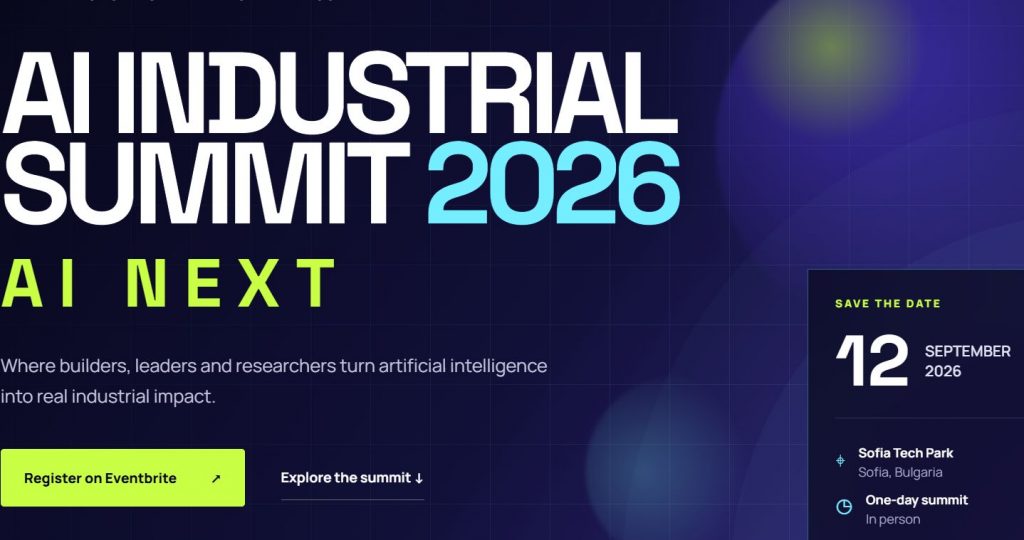
Saturday, 12 September 2026 | Sofia Tech Park, Laboratory Complex Building (Halls 1, 2, 3)
This Saturday, Bulgaria’s technology community gathers at Sofia Tech Park for the AI Industrial Summit 2026 — a full day dedicated to the people, tools, and ideas driving applied AI forward. The programme runs in English and centres on the practical side of intelligent automation, connected systems, and the technologies changing how products and businesses come together. BRAIN++, Bulgaria’s first AI Factory, will be present throughout the day, from the opening through a dedicated hour of its own.
BRAIN++ on Stage: From the AI Factory to AI Sovereignty
The BRAIN++ contribution opens with Prof. Simeon Stoyanov, Manager of BRAIN++ and Business Development Director of the Discoverer Supercomputer. Simeon’s work sits at the meeting point of artificial intelligence and high-performance computing, connecting both to the real needs of businesses, researchers, and public institutions. At the Summit he sets the frame with the Factory’s central mission — Bulgaria’s path to AI sovereignty — and takes part in the opening panel, AI NEXT: From Intelligence to Industrial Impact, alongside BRAIN++ partners.
He is joined by Zvezdelin Borisov, Agentic Workflow Architect at BRAIN++, whose focus is AI solutions architecture and operations: designing agentic workflows and turning AI use cases into deployable systems. His perspective keeps the human firmly in the loop, tying intelligent automation to human judgement and responsibility — a theme that runs through much of the day’s discussion.
The Questions the Team Will Tackle
Following the opening, the BRAIN++ team turns to a set of questions that define where applied AI is heading. Elizabeth Koleva opens the technical discussion by weighing open against closed large models — the trade-off organisations face between the control, transparency, and local deployment that open models allow, and the speed and maturity that closed services can deliver. As she’ll argue, the honest answer for industry is rarely one or the other, but a deliberate balance of control, cost, security, and pace of innovation. She carries the same lens into the world of AI agents, looking at open versus closed agent harnesses and development environments. Here the question widens: as agents spread, what matters is not only which model sits behind them, but who controls the environment in which they act, reach for information, and make decisions.
Simeon returns to the theme closest to the Factory’s purpose — national sovereignty and the human-in-the-loop. AI sovereignty, in this framing, means retaining strategic control over data, infrastructure, models, and other critical dependencies rather than handing them wholesale to external providers. And where decisions carry real social, economic, or security weight, keeping a human accountable in the loop is not a nicety but a necessity.
Christina Baycheva takes the conversation into how software itself is now being built. She contrasts vibe coding — building applications, automations, and prototypes at speed through natural language, pulling business users right into the development process — with traditional business process automation and its fixed, predefined workflows. The shift she describes is subtle but significant: AI-native approaches can adapt not just the software but the process around it, shaping themselves to context and intended outcome. She closes on the largest question of all — the changing relationship between people and machines. The old question of who we are and where we’re going, she suggests, is giving way to something clearer: a hybrid human–AI society in which people and intelligent systems work, decide, and evolve together. What remains open is how we choose to shape that relationship — on whose terms, and to what end.
More info and registration: AI Industrial Summit 2026 – AI Next