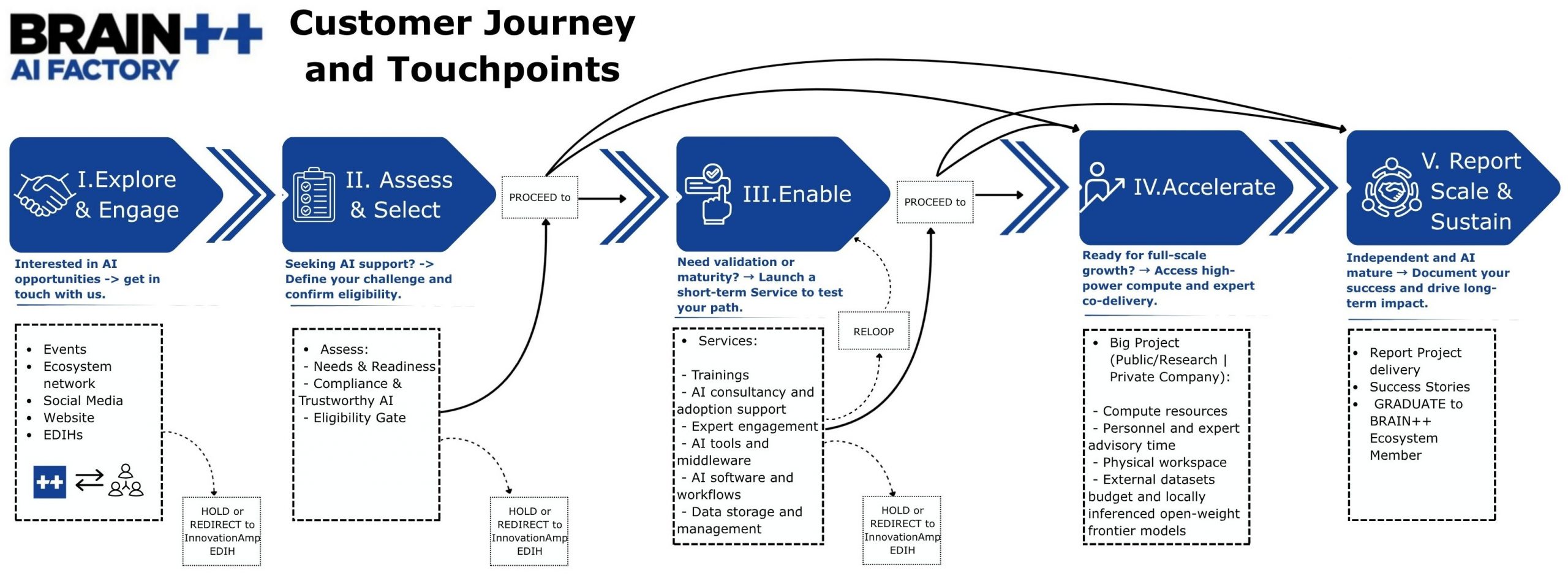
From First Idea to Supported AI Project
A clear five-stage route from initial exploration and project assessment to implementation, impact reporting, and long-term participation in the BRAIN++ ecosystem.
Support adapted to your level of AI maturity
Every BRAIN++ engagement follows a structured journey designed to ensure clarity, fairness, compliance, and efficient use of resources.
Some applicants arrive with clearly defined models and infrastructure requirements. Others need hands-on support to identify a suitable use case, evaluate data readiness, and determine whether AI is the right solution.
BRAIN++ combines access to high-performance computing with business advisory, technical expertise, compliance support, training, and ecosystem connections.
The complete BRAIN++ engagement flow
Choose the level of support that fits the project
The assessment process determines the most appropriate access tier according to project maturity, impact, technical needs, and resource requirements.
Services
Short-term support for exploration, assessment, training, validation, technical advisory, and lightweight experimentation.
Big Project
A structured development and deployment route for eligible public-sector and research organisations.
Track: Public / Research
Big Project
Full-scale AI development for eligible startups, SMEs, scale-ups, and other private companies.
Track: Private Company
Strategic / Core
Long-term national or European initiatives established through a separate route outside the standard open funnel.
Five stages from first contact to long-term impact
Explore & Engage
Discover where AI can create value and establish the organisation's initial challenge, opportunity, and level of readiness.
Typical activities
- Discovery meeting or introductory call
- Opportunity discovery session
- Innovation pathway discussion
- Business challenge and use-case exploration
- Preliminary AI maturity discussion
- Funding and ecosystem guidance
Expected outcome
- Applicant profile established
- Challenge statement defined
- Initial AI opportunity identified
- Preliminary AI maturity view
- Named BRAIN++ Coordinator
- Agreed pathway to assessment
Applicants with a defined AI challenge proceed to Stage II. Organisations that are not yet ready may remain in the nurture pipeline, while primarily non-AI or basic digitalisation needs may be redirected to InnovationAmp EDIH.
Assess & Select
Transform the initial idea into a structured, evidence-based project concept and determine the correct access tier.
Assessment covers
- Organisational needs and AI maturity
- Business case and use-case prioritisation
- Technical feasibility
- Data readiness and governance
- GDPR and EU AI Act considerations
- Ethics, cybersecurity, and trustworthy AI
- HPC and AI Factory resource justification
Expected outcome
- Validated project concept
- Readiness and feasibility assessments
- Defined resource requirements
- Completed Project Access Application Form
- Project Reference Number
- Compliance-gate result
- Selection Committee decision
Compliance items are recorded as Pass, Mitigation required, or Fail. Applications passing the gate proceed to independent evaluation and access-tier confirmation.
Enable
Turn the approved application into an operational engagement through contracting, onboarding, technical preparation, and service delivery.
Typical activities
- Service definition and project scoping
- Resource and infrastructure planning
- Resource Access Agreement preparation
- User accounts and technical access
- Project team and expert assignment
- Milestone and KPI definition
- Workspace, tools, and environment setup
Support available
- AI consultancy and adoption support
- Expert engagement and mentoring
- AI tools, middleware, and workflows
- Sandbox and development environments
- Data storage, staging, and management
- Training and capacity building
- Compliance and project-management support
No resources are activated before the Resource Access Agreement is signed. Services-tier engagements may complete in this stage and proceed directly to Stage V. Big Projects continue to Stage IV once fully enabled.
Accelerate
Develop, test, optimise, and validate AI solutions at scale using BRAIN++ compute infrastructure and expert support.
Typical activities
- Project kick-off and workplan confirmation
- Model development and experimentation
- Fine-tuning and distributed scaling
- Data staging and validation training
- Performance optimisation
- Production-scale experimentation
- Progress, utilisation, and stage-gate reviews
Possible resources
- H200 and GB200 GPU hours
- Senior and junior expert hours
- Physical workspace
- External-dataset budget
- Open-weight frontier-model token budget
- Specialised data and collaboration tools
Stage IV applies to Big Projects only. Progress, milestones, risks, KPIs, and resource utilisation are monitored throughout delivery.
Report, Scale & Sustain
Measure impact, document results, identify growth opportunities, and establish a long-term relationship with the BRAIN++ ecosystem.
Typical outputs
- Impact Assessment Report
- Final close-out report
- User-satisfaction assessment
- Success story or case study
- Growth and scaling roadmap
- Follow-on funding opportunities
Long-term opportunities
- Ecosystem networking
- Investment-readiness support
- Incubation and acceleration connections
- Community mentoring
- Collaborative open challenges
- Future joint projects
A graduated User returning with a new use case re-enters the journey at Stage II, with the new engagement linked to the original Project Reference Number.
A flexible route with documented next steps
Not every applicant moves forward in a straight line. Each decision is documented and linked to a clear next action.
The applicant meets the relevant requirements and advances to the next stage.
Additional information, mitigation, preparation, or approval is required before continuing.
The need is better served by InnovationAmp EDIH or another external support route.
A Services engagement repeats a short workflow, training, validation, or advisory cycle.
A previous User returns with a new use case or applies for a higher access tier.
Transparent and documented decision-making
- Administrative completeness check
- Eligibility and compliance gate
- Independent scoring with written rationale
- Selection Committee validation
- Documented access decision
- Resource Access Agreement
- Defined milestones, KPIs, and reporting obligations
- Stage-gate monitoring for Big Projects
- Formal project close-out
Formal selection criteria, scoring bands, and thresholds remain governed by the relevant BRAIN++ access and selection documentation.
Target processing times
| Stage | Target timeline |
|---|---|
| Administrative completeness check | Within 10 working days |
| Eligibility and compliance gate | Within 10 working days after receipt confirmation |
| Selection Committee scoring | Within 10 working days after gate clearance |
| Applicant notification | Within 10 working days after the committee session |
| Resource Access Agreement signature | Within 10 working days after approval |
| Private Big Project Participation Agreement | Concurrent with the RAA or within 5 working days afterwards |
What applicants should prepare
Prospective applicants can first contact the BRAIN++ team to discuss their project and confirm the most appropriate route.
- The business, research, or public-sector challenge
- Why AI may be an appropriate solution
- The intended users and expected impact
- Available and required data
- The proposed technical approach
- Relevant GDPR, AI Act, ethics, and cybersecurity considerations
- The project team and organisational capacity
- Required compute, expert, workspace, and data resources
- Planned milestones and KPIs
Take the next step in your AI journey
Whether you are exploring your first AI opportunity, validating a use case, or preparing a full-scale implementation, BRAIN++ can help identify the right support and next step.